
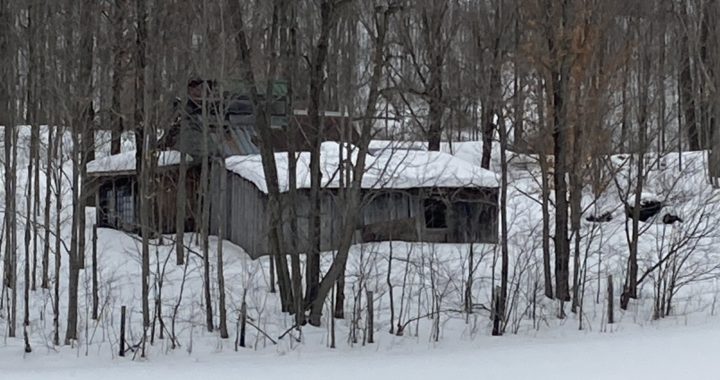
March is a special month for us here in northern N.Y.!Why?Maple syrup season! It’s a hobby that I have enjoyed for many years now. The story of how I came to love it so much is rich with family history and rural heritage. As the first of March approaches we plan on getting started setting our taps. It always reminds me of my father in the last few years of his life. He never wanted to start tapping until March 15th. I’d be impatient and would say “let’s get going! “He’d simply say “we’ll start soon but not just yet!”I can’t say for sure when we first began to sugar on our farm. My parents purchased the farm around 1969.There was an existing sugar house and old evaporator over in a small section of woods off the main farm meadow. Sometime in the mid to late seventies my two uncles and my father partnered up to make syrup together. My father worked and I had school so they did much of the gathering and boiling. I enjoyed going over in the evenings when some of the boiling was done. I honestly can’t remember a whole lot in the haze of time gone past but I remember certain moments clearly.Like the time I wacked myself in the head with a block of wood I was attempting to split. My cousin was running the evaporator and I wandered off for awhile to suffer my humiliation.Another memory that stayed with me was when my uncle Charlie shared a sub with me! It was the first one that I had ever eaten! Funny the things we remember! I can’t say for sure how many years we did syrup while I was in school but I know that the evaporator pans got bad at some point and couldn’t be repaired easily. My uncles built their own sugar house on their farm and tapped their large stands of maples close to home. I would stop in and visit sometimes when they boiled at night. My father’s cousin Keith Tyler also began sugaring and we would visit there sometimes. Our sugar house sat idle for quite a few years. The back wood shed section roof rotted through and I tore it down one summer. My father rebuilt it later that fall. The main sugar house structure was an old garage the previous farm owner Forrest Hosmer had moved there sometime in the fifties. It needed a new roof but has stood the test of time. My father expanded the wood shed for better storage space but the structure has changed very little over the years.It wasn’t until just before my father retired in 1990 that we returned to making syrup on a yearly basis. He had two custom pans built for the old evaporator in Vermont. He gathered sap with a team of his horses. My stepmother Shirley was his partner in the sugarbush. I helped out with tapping and some of the sugar wood collecting. My memories are a little vague and I miss my journals that were destroyed in our house fire of 2012. They contained a wealth of details that I can’t ever hope to drag from my memory. But beginning in 1991 something occurred that would change me forever. My memories are clear and concise of the day my father decided that I would learn to run the evaporator for the first time! I was nervous and a little intimidated by the responsibilities that come with that task! There’s a lot that can go wrong if you don’t pay close attention. But my father patiently guided me through the process and I caught on quickly. I wasn’t working that spring and spent a lot of time helping with sugaring. I did a lot of the boiling and my passion for the sweet creations that flowed from the evaporator became something more.I found a special connection in the rising steam of the boiling sap. There’s a poetry of motion in the process of running the evaporator. My father would come in between delivering loads of sap and visit with me. He’d tell me stories of growing up and sugaring with his father Alvin. It was in those days of boiling sap that my father became my best friend. We already had a special bond but something changed. He was passing on the yearly tradition with fatherly hope for the future I’d realize later. I grew fond of boiling sap at night. We had no electricity in our sugar house so a propane lantern supplied the light to run the evaporator. Our sugar house had been cleverly constructed on a side hill and everything worked on the principle of gravity. No need for pumps. I spent a lot of time alone boiling sap at night and found it relaxing despite the busy routine. The evaporator became predictable as I learned it’s needs for sap and firewood. A practiced routine of stoking the large fire box developed. Testing the boiling sap and drawing off the batches like clockwork. Filtering the hot syrup and jugging it up. There was little time for sitting until the end of the day when most of the sap was gone. The process of firing down has its own list of tasks before shutting down completely. There was plenty of time for thinking though. I kept a pen and notebook handy for jotting down random thoughts. I kept no meal schedule and basically ate whenever I could grab something out of my lunchbox. In any given day I consumed a fair amount of fresh syrup. I sample a small amount from each batch. Over the course of a long day it adds up! But crafting quality maple syrup is a prideful vocation and I strive for success. We’d average about 10 gallons a day with a decent sap run. But sap runs are fickle and unpredictable. We’d sometimes find ourselves swamped by a huge run and I’d find myself putting in an extra long day. 24 gallons is pretty much my one day record for our small operation. That’s a long day!The years passed and I found myself increasingly busy with my work. But I’d always find time to get to the woods for the gather. Saturday’s and Sunday’s were spent boiling to give my father a break. I managed to be off work some syrup seasons and it became a goal of mine. Get time off for sugaring! Not something every employer understands or tolerates well. No matter! When your hobby lasts only a few weeks each spring there’s no time for postponing it. So I managed as best I could to find a balance. After all, there’s a finite number of syrup seasons in a person’s life! I remember the spring of 1994. I was in between jobs and looking forward to maple syrup season when a call to return to work came one afternoon. Oswego County. Too far to drive so I had to live out of town. But I would return each Friday night to be able to help out in the sugar house for the weekend. The ice storms of 1991 and 1998 heavily damaged our sugarbush. We cleared the trails and salvaged the firewood. We had to say goodbye to some of our favorite trees. It’s painful in a strange manner. But that’s nature. Some seasons were short and others were almost perfect. Weather is the biggest factor of sugaring. So here I am.Thursday.March 4th.2021. We started setting taps Monday. We hit a count of 62 then a wind driven snow storm forced us to quit. Bitter winds and cold the past two days have kept us out of the woods. We hope to resume our tapping tomorrow. The weather is breaking next week and we need to be ready! Time will not wait nor will the sugar season.Perhaps we tried to start a little too early this year. I know we missed a small run over the weekend. But maple sugaring is a game of chance and circumstances. Weather can’t be controlled. We lost our father and maple syrup mentor in June 2007. That spring was our final syrup season together. But I haven’t missed a season since. I miss my father in the sugar house. My stories of maple sugaring are many and will flow like a plentiful sap run in time. This story but lays the groundwork of a passionate hobby that borders on an obsession. There’s a magic in the motion of being a “sapsucker”. There’s an energy that I chase within our fervent endeavors. It surrounds and permeates the body with a peace that words will never capture. It must be experienced in all its many forms. In all the weather one can imagine the season will arrive and quickly pass. It’s time these stories were written and shared. But “not just yet”!
Category Archives: Farm
Farm Life

Cold Memories From A Warm Heart
A cold morning at Hill House this morning!It’s been a strange winter for sure!Quite mild actually, with minimal snow.The Lake only sports about 8 inches of ice down in front of the house. After last night I expect that changed. As I stepped out to fire the outside wood boiler (aka The Monster) in my bathrobe and Crocs I realized there was a significant wind chill also. A bathrobe and Crocs is standard attire for a retired person up here on the hill. After all what’s the hurry? It’s that time of winter when the increase of daylight becomes noticeable.Icicles form and drip as the sun hits them. Mini avalanches send snow sliding off the southern and western portions of the metal roof with startling rumbles. I have a lifelong fascination with ice. Walking on it.Following the streams and exploring beaver ponds. Taking shortcuts across it to save time. Always looking for that perfect picture of it hanging from ledges. Amazed as the lake ice booms at night as you shine a flashlight on a night set walleye tip up. Ice is powerful. Cracking concrete. Moving foundations and lifting asphalt. A morning such as this reminds me that this morning’s temperature of 7 degrees Fahrenheit is nothing! I am always telling my teenage son Zane about the cold winters of my youth. He scoffs and says “ older people always say things like that!” But I remember many cold days and nights from years ago. The weather began to take a sudden turn here sometime in the eighties. More unpredictable and sporadic. We still had some fierce winters but things were much different. The winters of 1993 and 1994 were some of the coldest in recent history as I recall. The winters of my youth were rather predictable most of the time throughout the seventies. Late November would find the freeze up beginning. By Xmas time the ice was nicely formed and the snow would begin to accumulate. The temperatures would continue to plummet and by January it could be brutal!We would however often get a January thaw that would last a few days then disappear. Nothing like the up and down cycles we endure here now each winter. Sure there were abnormalities and breaks in the patterns occasionally. Typically after the January thaw the weather would remain very cold till March.The first two weeks of February could be some of the coldest we’d get all winter! The sun might shine but when’s it’s minus 20 or below it didn’t matter much! Growing up on the farm winter changed the routine immensely. Everything was more difficult. Snow to shovel.Hungry horses and cows stabled in the warm barn to feed twice a day. Their waste to be removed from the barn each day.Water to keep from freezing as well. Doors and feed holes always sticking. Saturday’s would find us out with the team of horses cutting firewood. We pulled a big work sleigh for hauling the wood to the farmhouse. No fancy dry weave or nylon clothing. Wool was the answer to keeping warm. Wool pants and chopper’s mitts. Wool toques the standard fare. The job of the farm boy was to always break the sleigh runners free with a large steel bar before they could be moved.They’d freeze down to ground and take some effort to free. It was a cycle of life that became the normal. I think it’s why I have this tremendous connection to the seasons. Sometimes it would be too cold to even venture out to work. But that was rare. The daylight would increase and we’d skip work some Saturdays. We’d load our gear and head to the lake for a day of ice fishing. We’d drive right across the lake with the truck on 20 inches plus of ice.Great memories!One winter especially comes to mind. It was 1978 headed into 1979. Xmas day a balmy -25 degrees Fahrenheit. The oil filter on the Ford Mercury burst when trying to start it. The days of that winter would see a 30 day plus run of days that never got above 0 degrees Fahrenheit! Brutal and testing the limits of people and machines! I learned the tricks of survival.Battery chargers and booster cables. Dry gas to keep fuel lines flowing. Fuel injection not yet common as carburetors ruled the realms of internal combustion engines. We didn’t own anything diesel then. The winter of 1979 and 1980 was equally cold. As I think back over the years I can remember so many brutally cold days and nights. So today feeling cold at 7 degrees Fahrenheit seems wimpy! I think we need to put on some dry weave inner layers with a nylon outer layer. Maybe my Gortex hunting jacket. I have been eyeing the real wool outer wear they sell at a store in Malone,N.Y. Perhaps it’s time to return to the old ways. Or maybe a blend of both worlds. One thing I can’t buy at any price is a pair of my Grandmother’s hand knit mittens. Or a wool jacket with a hand stitched cotton neck liner to keep the wool from irritating my skin. We survived those challenging days of years past. We’ve grown soft perhaps with these new winters. Those winters of our ancestors were very real! Not just a figment of aging memories. I know! I lived some of them! Close to nature. I am the fortunate man. To know the swing of seasons with passing days.To learn to care for livestock. To know the value of home heating fuel that came from the forests of the farm. To appreciate the warmth of the farmhouse at the end of the work day. Meat and potatoes to replenish and nourish the weary body. My roots are deep and well planted. For that I know I am truly blessed! The memories will never die if I keep them alive with words. Some things are best left forgotten but some are not. The stories are many and wait to be dredged like buried gold from the years. To leave them uncovered could be a loss. For Zane and all my family. “It’s no bad thing to celebrate a simple life”. (J.R.R. Tolkien)

Tired Iron
Choosing a title for a post is a fun part of the process!Always searching for a short combination of words to make a point,tell a story, or leave a message of positive thoughts. I can’t claim ownership to the term “tired iron”. I simply borrow it from a conversation I once had with a local “collector”.He ran a mixed antique/collectibles shop.He’s what we call a junker! (“Junking” is another hobby of mine that gets us into some interesting shops and barns around the north country.)The junker owner was showing me his collection of old cars and trucks with great enthusiasm and knowledge of each.He then referred to them as “tired iron”. I have always remembered the term. I use it now when I refer to the old farm equipment around our farm. Rusty with weather checked tires,it’s stored here and there in my various buildings.It sits idle much of the time but is safely held in trust for “that time”.A time when it may be needed and pressed back into service. Machinery isn’t the only tired iron around the farm! I have lots of other things of questionable value!Space is privilege of those who have it and my spaces are full!Many of my prized pieces of tired iron actually perform productive tasks!Our old evaporator is great example!Also our mixed collection of other maple syrup equipment.It sits stored and ready to go mostly.Nothing a patch here or a chunk of tie wire there can’t fix!We keep a set of worn out hand tools in the sugar house always.We use things that are actually antiques around the farm on a regular basis. Things many people can’t name let alone know how to use them.When my mind reflects on all repaired tired iron that’s used on the farm I begun to examine myself. I’m mostly flesh,blood,and bone but I do carry a few screws and a plate. (Stainless that can’t rust!)Fillings in my teeth. A bicep repair with nylon screws and surgical bindings left in place to hold me together.An interesting comparison if not a little strange.Speaking of strange!I have strayed so far from my original thoughts for this post that it’s going to take some effort to bring a reader back to my intended message! To get there quickly I’ll simply say my latest piece of tired iron is my nine year old outside wood boiler. Sold with a long term warranty that isn’t worth a well tarnished penny. I patched it together with determination and luck in February of 2019 after it breached while cleaning it. That fall I did some premeditated repairs to another section where I suspected a problem might develop. It’s held together well until last night. Major breach number two on the coldest night this fall.A total “ I’ve got to shut this down and plan a repair now moment where it’s questionable if a repair is even possible”.But this is where the message comes into play. I started getting really down. Irritated and thinking why me? It really was threatening my day or worse the next bunch of days. But it all came down to preparation. I had known the boiler might fail me. We put backups in place. So it was time to switch modes and get moving!Having a plan helped. It was then that I realized something.This was not the end of the world. This is nothing new for me. Problems grow less the moment we face them with possible solutions. I thought of people trying to overcome much worse situations. I am fortunate to be capable. Determined to do better. Tired iron breaks down. It can be patched if a person tries. It doesn’t need to last forever. Just a little while longer.If it can’t be repaired it must be accepted. Cut the anchor rope if it tries to sink the boat. Be happy to still be in the boat. It’s not a shoreline of dry,safe land that’s easy to reach. But calm seas never make for skilled sailors.Count your blessings even when your “tired iron” gets heavy!