Beyond It’s On.

The daylight increases with each passing day as summer solstice quickly approaches. It’s been a busy spring between my part time work and everything else that needs to be tackled post maple syrup season. There’s equipment to clean and store as well as a sugar house to fill with firewood for next season. We have managed to procure some decent slab wood to fast track the process. I was fortunate to secure some Adirondack goof off time while camping back in May. I will start the story there as several memorable events occurred.

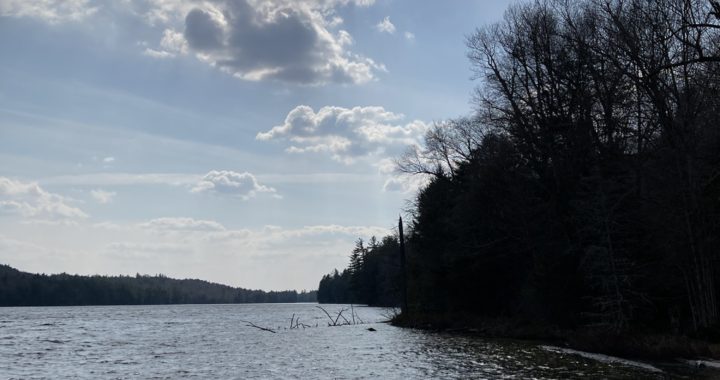
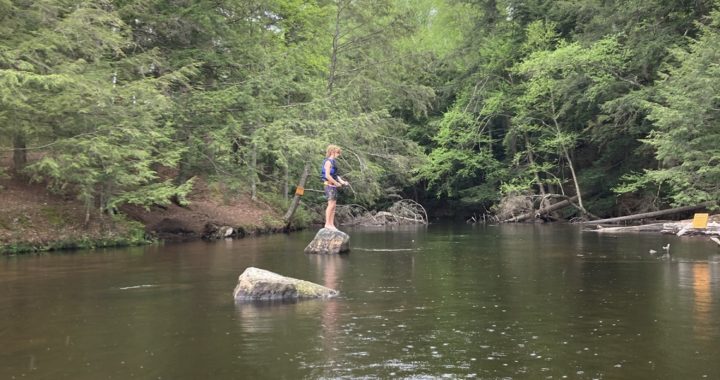
I briefly posted on May 23rd about the start of the 2022 camping season. It’s the post titled “It’s On!”.This post highlights some of the more memorable events that followed. It started out a bit wet my first week of camping but I found time to finish a novel that I had been reading for some time. I got caught in the rain one afternoon while paddling up the Fish Creek and headed to Floodwood Pond. It’s a lovely paddle through narrow connecting waterways in a couple of spots. It got pretty windy as I was returning especially on Little Square Pond. Waves don’t trouble me too much typically but it had gotten rather chilly and going into the water wasn’t something that I relished all that much. Gracie held down the bow of the canoe which always helps me control my progress into the wind. She’s a good canoe dog until we get close to shore and she can’t wait to hop out. This backfired on her recently when she jumped out into deep water and totally submerged for a moment! Back at the camper I turned on the furnace and got dried out after awhile. Gracie retired to her dry blanket under the camper out of the rain. My evening was spent reading and enjoying a simple dinner that I made inside the camper. Outside cooking is great but only when the weather cooperates! Jen showed up on Wednesday and we explored Lake Luey near Indian Lake with the canoe. The rocky face of Snowy Mountain got me thinking about the weekend. After paddling we ventured over to Longview Lodge in Long Lake for dinner. It’s a favorite place of ours while staying in the Adirondacks. Great food and a nice atmosphere.A bit pricey but we feel it’s always worth it!The following day was spent exploring the area leading up into the Moose River Plains on a car road trip since it was raining intermittently. I hope to further explore this area sometime when the gates are open. They are kept closed during mud season and open just before Memorial Day. This roughly 80,000 acre tract offers primitive camping along the dirt access road. It’s destined to be a future adventure journey!

Friday found me returning to Hammond to pick up Zane and bringing him back up to the campsite. He had expressed some interest in hiking fire towers so I mentioned Snowy Mountain which has one. We decided to hike there Saturday as the weather looked promising. It was going to be a hot one and the black flies would be out full force!Saturday morning came quickly and we decided to stop for brunch at Chef Darrel’s Mountain Cafe in Blue Mountain Lake before tackling the mountain. The dogs ( Friday we had picked up Stella!)were welcome to sit outside with us on the deck. Great breakfast of eggs Benedict washed down with vanilla milk shakes. Anything goes at brunch time!Fully fortified we headed to the trailhead several miles beyond the hamlet of Indian Lake. I hadn’t told Zane the entire story of why I wanted to climb Snowy Mountain.

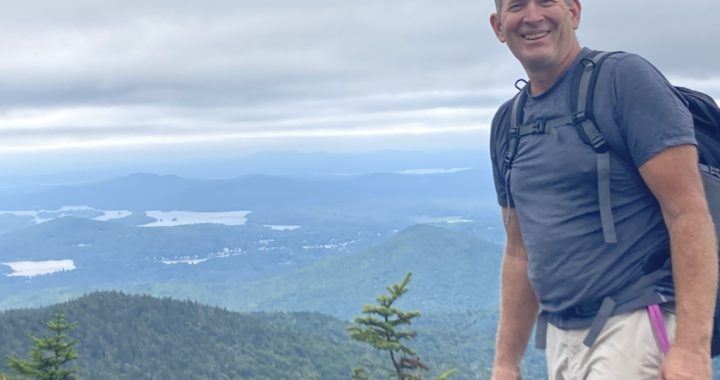
Snowy Mountain is known as the 47th Adirondack high peak unofficially. That was the draw for me but the fire tower had convinced Zane to go. There was some confusion however about the total distance round trip. One site listed it as 7.8 miles while another said 7.1 miles. The state sign by the road said 3.4 miles one way. 6.8 round trip. No matter we decided. The hike to Snowy Mountain started out fairly easy and there were plenty of streams for the dogs to enjoy.The trail was well maintained and wound its way through a mixed deciduous growth with many large trees. Eventually the trail began to ascend quite aggressively and the forest changed to conifers. There were a few other hikers on the trail most of them returning from the summit. The black flies weren’t too bad provided we were moving. It was hot most definitely and the dogs were overheating at times. Zane dunked his head and upper body into a super cold stream while the dogs were resting. The trail continued to rise and the streams were left below us. The trail became steep and rocky with a trickle of water keeping some of the flatter surfaces slick. It’s a game of foot placement for me. Zane leaps and scrambles with a recklessly controlled rhythm. I envy his youthful ease! I was feeling somewhat out of shape but managed to keep up rather well. The dogs were struggling with some of the steeper rock scrambles but managing well overall. The last section before the false summit was quite aggressive but we soon reached the flat overlook below the actual summit. Further up we found fire tower and no view whatsoever. At the top of the fire tower the views were incredible! The dogs only went up partway however as the wire fencing surrounding the stairs was missing near the top. Too risky for them we decided. We took pictures and celebrated our latest summit! The return trip was difficult for me and seemed to last forever. I joked with Zane about it being 3.4 miles in and 3.9 miles out! The black flies increased their intensity and became rather irritating. We finally reached the car and enjoyed the return trip. Hot showers and dinner made for an early evening. We spent the next day paddling up to Floodwood Pond and catching a few panfish for fun. We released all of them even the keepers. And just like that the weekend was over.

The remainder of camping trip was spent working at the Olympic Center in Lake Placid. Evenings were short after a 10 hour work day and short commute back to the campsite. Jen came up Thursday night and we hit another favorite restaurant of ours in Tupper Lake. It’s called Amado. Brazilian flair with several unique entrees to try out. We always enjoy it there! Pet friendly in certain sections too! We packed up the campsite some Thursday night and did the rest Friday morning. The trip was over! A successful one filled with special memories! MOONTABS!Adventure waits for us to discover it. The thrill of new destinations and the comfort of familiar settings. Balanced out and lived to the fullest! ✍️
Beyond The Run Of The Mill

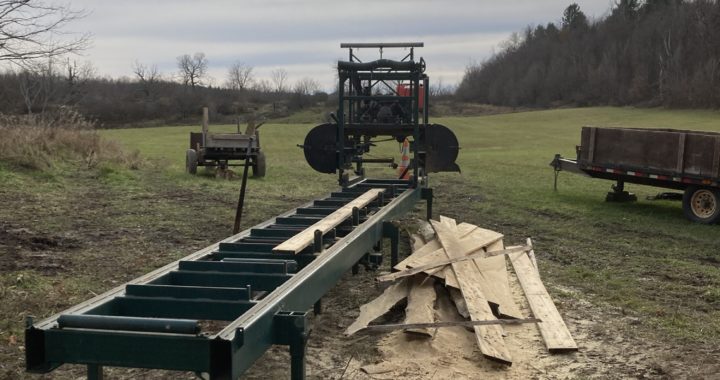
Several months ago I began the “Run of the Mill” stories as a manner in which to preserve some of my personal rural heritage history. People have told me that they wish to hear more of those long past decades. I have a tendency to wander aimlessly through those decades.It’s all connected though! Often my certain memories are triggered by the changing of the seasons. I feel that affords better story telling with greater emotional connection. One particular set of memories stands out with a certain clarity beginning in 1996. A series of events began to connect and would ultimately lead in unexpected directions. It started quite simply in 1996 with the purchase of 110 acres of rural property on the edge of the Macomb/Rossie town boundary. It was a mere 7 miles from my father’s farm giving it the advantage of proximity but there was a larger draw. The undeveloped potential of the land. There was a modern element of homesteading that appealed to me in some unique manner. In fact many years prior to purchasing the property I had driven past different times and noticed that very potential. I had always expected someone to develop it but it never happened. The main feature of the property that caught my eye was the open meadow that stood at the base of a wooded ridge line. There were no power lines on the property nor access roads of any kind. It’s difficult to say why it held such appeal but I suppose it was the sheltered way the meadow was tucked in between the surrounding ridges. Also the fact that there were no neighbors in sight either. One day in 1996 I noticed a small For Sale By Owner sign by the road. I walked the property with the owner and was immediately hooked.We had strolled through the numerous stands of tall white pine and found ourselves on the bank of the Bostwick Creek. A group of ducks gave flight from the lower end of a large beaver pond and flew up over a steep ridge of red oak trees. A small meadow sat adjacent to the beaver pond in a basin of sorts surrounded by forest. I knew that the property was perfect at that point. It would take some work to make it a homestead but I found that exciting actually. Perhaps I envisioned myself as some type of pioneer. Some trimming and clearing began later that year along the edges of the meadow. I laid out the driveway first and it was installed in 1997. It was built right along the edge of the forest so it would be minimally invasive to the meadow’s appearance.The site for a 26’x40’ garage/barn was staked out for construction that fall.Some test holes were excavated to determine if a cellar was possible for the future house. Macomb is known for its veins of bedrock that reach the surface with no predictability.No bedrock was discovered but the hard clay soil of the meadow’s side hill would require custom drainage systems. Big plans were brewing for 1998.The hard work was truly about to begin! As winter approached I cut a logging road into a back section of the property where some of the white pine was beginning to die off. In January my father and I began to harvest white pine logs from the property using a team of horses that he trucked in on Saturday mornings.An area of the forest was targeted and we constructed a landing in a slightly open spot under some large pines that were to remain. I did all the felling and limbing in addition to hitching the logs for skidding. The logs were skidded a short distance to the landing then loaded onto a horse drawn wagon and taken out to the edge of the highway to be piled on a side hill staging area.Mid day we would eat our lunch right in the woods while the horses munched on some hay my father had brought in a grain sack. It was busy work and we left tired at the end of the day. We worked the same section for several Saturdays and made great progress due to the lack of snow. I clear cut my way through the stands leaving plenty of young healthy trees beyond the slash. A buffer zone now lay between the dead trees and the living. The pine logs were high quality and very fun to fell! Tall and straight with few limbs near their bottoms. There was a certain thrill in the prospect of turning them into lumber as they fell one by one with crashing roars. I would get lost in the work and move from one to the next. Using a chainsaw requires focus especially when limbing. The large pines often crush smaller hardwoods when they land. These bent over saplings possess incredible stored energy and are very dangerous to the feller. Spotting them is crucial to avoid injury! I call them “slap sticks” and for good reason! I employed a “layered” approach to the felling. I would fell a pine and trim it into skid logs which my father would then extract with the team. The next tree would be felled on top of the “slash” layer. The aftermath looked a little raw but the amount of young pine that remained standing was impressive to say the least. We would never lack for building materials provided the forest remained healthy. It is interesting to note that the slash areas healed quickly over the subsequent years and the skid roads became handy access trails for harvesting firewood.Later that spring we targeted another stand of healthy trees close to the future garage site.Another access road was carved in following the lay of the land. Staking out the access roads was a pleasant job that I truly enjoyed! A large network of potential trails began to appear to me at this point and I envisioned the true potential of a sustainable,healthy forest plan. That story must wait for now. I crafted a landing near the targeted ridge where we would be extracting logs. This area was experiencing a die off similar to the one we had just harvested. The cutting yielded some very large logs that were perfect for creating pine siding boards. This section of forest contained more hardwood species so felling was a bit tricky! The logs were hauled by the horse drawn wagon out to the driveway area to a second staging area.A higher section of the ridge had been heavily damaged by a wind event. I began to map out a future trail system to reach the area for a salvage cut. It was a fun part of the homestead process for me. The raw and undeveloped property was an ideal project of future forest stewardship. The property was so much different than the semi-open farm property where I had grown up.It was a true forest of some magnitude and I loved exploring its rolling terrain.From the clearing of the second landing the ground fell away into a deep valley.The back meadow and beaver pond on the Bostwick Creek were visible from there. It was a lovely place to relax and dream. We decided that our stockpiles of logs were adequate so the logging was concluded. Sometime in April after maple syrup season we trucked the logs to the Amish sawmill to be custom sawn for our barn/garage framing requirements.All the lumber was trucked back and unloaded by hand. I stacked and “stickered”it up on top of crib piers that I constructed from concrete blocks. Stickering lumber allows it to air dry by keeping the pieces separated by narrow strips of lumber. We hired a backhoe operator to prep the hill side garage site and managed to it leveled for building. An Amish crew began to work shortly after. Footers were poured and layers of block were laid to build the garage into the side of the hill.The barn/garage was tucked into a notch in the meadow at the end of the driveway. The gambrel roofed barn/garage went up quickly and was soon finished minus the doors. I made some temporary doors from plywood that fall and stored extra lumber inside. Electricity was brought to the corner property a year later after reaching a deal with the power company. Conduits were buried to bring power and phone to the garage to keep the pristine appearance of the meadow intact. . The stage was now set for the next part of the homesteading project. Planning began for the actual house. It would be constructed in 2001. The logging project that led to the barn/garage being built brought a sudden realization to the table. Why haul logs from the property only to haul the lumber back again? We began to consider buying our own sawmill from that day forward. My father pushed for the purchase and in 2003 I agreed to buy one with him. We chose a portable sawmill that was popular with the Amish. The Brubacher . Made in Canada using minimal hydraulics and no high end technology. We chose the gas powered option with a 25 horsepower Robins Subaru engine. Capable of cutting a 20 foot log with a 30 inch circumference. Solid and sturdy in its simple design. The new direction began to show itself that year as I learned to become a sawyer. I began to recognize my connection to my late grandfather as he had been a logger and sawyer in the 1960’s. My father had worked in the woods his entire life as well. I was already close to my father and frequently worked with him at the farm but something new was beginning to take shape. A new era of bonding and deeper father/son friendship formed as we began working together with our new sawmill toy. If only I could gift that feeling to the world and truly emphasize what it meant to me! A transformation was underway. One that would no unnoticed in the busy task of daily life. But the spirit energy would find me on the weekend when I walked the trails of the homestead property. It radiated from the scent of the pine lumber of the newly constructed barn/garage. Something much larger called out to be acknowledged in the hidden recesses of pine groves where nature ruled with quiet dominance.I suddenly began to question everything that was my normal vocation and began to yearn for something different. Looking back now I am truly thankful for all that followed. I can’t say it was planned and executed with a larger strategy. It just kind of showed itself and was decided along the way.It’s a story that deserves to be told in greater detail to truly capture the spirit of the moment. Many things were bound to happen. Many things did happen. These would be the years of self discovery and ultimately the start of something that continues to grow. The years of blood,sweat, and tears I’ve called them. They passed fast it seems now. I found a part of myself in those years that had laid dormant like a seed waiting for it’s time to grow. The spirit energy flowed strong and fast. My heart told me to chase the possibilities so I did. There are few regrets and oh so many blessings. Those memories I have named MOONTABS.

Tales Of An Ice Walker: The Origins

Yesterday we were rewarded with our warmest day in recent weeks. It’s been a cold winter overall with a respectable amount of snowfall. We haven’t had the up and down weather patterns of the past few years either. The strange thaws that bring rain and high winds to diminish our snow accumulations. It was late freezing up last December in 2021 but eventually it happened. January was more traditional with subzero temperatures and savage wind chills. So when the forecast yesterday called for temperatures in the high thirties with sunshine I decided to postpone everything and go snowshoeing with the dogs. My destination was easily decided without a moment’s hesitation. Beaver Creek. It’s my ground zero I suppose. That place where the Great Wander began decades ago. A place of countless stories and adventures that span over 50 years now. It begs an introduction. Then I will introduce you to the Icewalker.A me that you probably don’t know yet. Just what encompasses Beaver Creek? It’s the large gorge and wetland system that passes through an outer portion of our farm property. Rugged and tough to access with steep ridges on both sides for much of its distance. We own about 20 acres of it near the road but it’s difficult to travel until the winter ice forms. It can be paddled in sections but it’s impossible to remain in the canoe for long. Fallen trees and beaver dams choke it’s winding channel along its entirety. Once the winter ice has formed it becomes more hospitable for traveling. Snowshoes or cross country skis work well most of the time but there’s never a broken trail. Almost one one ever goes there. Sometimes I hike on fresh ice before it gets snow covered or immediately after a thaw/refreeze event. Ice creepers or crampons become necessary for comfortable walking. This vast wetland system covers some 10 miles beyond our property before another road crosses it. It then continues several more miles where it empties into the Oswegatchie River near Heuvelton, New York. Numerous small creeks add to its flow along its course adding to its size as it nears the river. It takes an east to west path basically. About a mile west of our property the gorge flattens somewhat into large hills and continues but Beaver Creek enters it from a different direction and joins a small runoff creek. There’s a lovely waterfall there on private property. If I was to describe the gorge itself I would say it’s close to an eighth of a mile wide with large wooded ridges on both sides. There are steep rocky ledges along many sections of it that are difficult to climb. There is almost no shoreline that allows for easy walking as you travel west along it.The steep ridges come right down into the edge of the swamp for miles. Large rock piles enter the swamp in a few spots. A geologist told me years ago that the gorge was created by a “shearing” event not from a glacial event. Time has eroded the vertical sides mostly but some remain. As for the wetland itself, there’s deep mud and grassy bogs beside a meandering channel of various depths. Beaver dams cross it entirely in certain spots in various stages of repair. The presence of beaver has altered the swamp dramatically since they were reintroduced to upstate New York sometime in the 1950s. Their dams flooded the stands of soft maples that grew throughout much of the shallow water along the main channel. The dead trees would fall into the swamp over time choking it and making paddling almost impossible until they rot under.What followed were large open areas of grassy vegetation and swamp plants. Jagged stumps remained above the water as a reminder of the forests that once grew here. Our property once had two large stands of soft maple forest. Two huge beaver dams that spanned the gorge would eventually kill them. Their bark free trunks and tops stood for years before we had the perfect winter conditions to salvage some for firewood. We clear cut about 40 cord one winter with horses and a sleigh. I harvested another 30 cord a few years later with a snowmobile then a four wheeler. Another winter we were able to use tractors to harvest. Needless to say the wetlands are constantly changing. Tag alders cover sections still as they seem rather resistant to the changes in the water depths. Just below our property a stand of soft maples has survived despite the beaver activity. The swamp is shallower here and the channel necks down into a choke point. In a canoe it is a wet portage point. A wade and push location where you need hip boots. Further down the channel widens and the wetland is open with few trees. It once was a soft maple forest but that was long before I first began exploring there. Now the gray, bark free stubs I remember as a boy have fallen and are no more. I have a stark memory of my first seeing them but it’s brief.To describe the creek and wetlands is to describe the scene of a constantly changing habitat. The invasive weed purple loosestrife started growing here sometime in the 1970s along the road on our property. We didn’t know what it was then or that we should have destroyed it. It spread quickly and its floating seeds have allowed it alter the wetland forever it seems. The grassy sections that were home to hundreds of muskrats each winter now lay covered with loosestrife bogs. Unfortunate and disturbing to me. So this was the playground of my youth. A place I spent my winters whenever conditions allowed. The early ice of December was perfect for exploration when I was a boy on foot. I didn’t venture very far though at age 9. That would come later. The deep snows would come and the creek would become the haunt of snowmobilers. The late 1960s and 1970s brought a snowmobile craze to our area. Beaver Creek became a popular trail system and saw a lot of traffic. We had a snowmobile by 1975 and I would follow the packed trails myself sometimes. We also would accompany others on occasion and travel larger distances. It was then that I got to witness the full magic of the gorge and it’s natural wonders. Ice falls with huge hanging icicles and giant cliffs that hovered over the wetlands. Trips to Huckleberry Mountain sometimes miles from our property. The snowmobilers have left the creek these days mostly. It remains wild and untraveled. It was on foot that I explored most of the territory near our farm. I became a fur trapper at a young age. 10 if I remember correctly. The Beaver Creek gorge was a trapper’s paradise! Muskrats everywhere! I later learned how to trap beaver. But that is another story in itself. Being a former trapper doesn’t always make a person popular these days. But it’s a proud part of my upbringing and rural heritage. Something I was taught that shaped my youth and taught me to appreciate the natural world in a manner some can never understand. Trapping would turn me into a great wanderer. It conditioned me to endure all sorts of weather and challenges. It fueled my imagination through history and the stories of the American west. I no longer trap but the love of wandering remains. I read the swamp like a book. Tracks and signs of wildlife activity like the words on a page. These days I wander the swamps to read the signs and reminisce about my youthful pursuits. I suppose you could say that the ice became my highway to discovery. It was the perfect flat road to travel. It could be covered quickly and great distances could be traveled in a day.Imagine that you are high above our farm property and could look down upon my adventures of wandering as I matured. It would resemble an epicenter of sorts. An ever growing circle that extended from the home base of the farm house. Each year to venture further and further away. My father worried constantly when I would disappear for hours. Especially when he knew that I was out on the ice. I eventually named myself the “ Icewalker” and coined the Icewalker’s motto. “The distance in must be traveled out”. Good advice that I learned by making countless mistakes. Potable water was never a problem years ago even in winter.There was snow to eat when necessary.I knew of numerous water sources that were safe for drinking. Springs we call them. Eventually however they became unsafe ( the snow as well!)and woe to me finding out the hard way! A sudden hot flash and the rumbling in the stomach a few times would end that habit. I rarely carried much food. A couple hard maple sugar cakes in a plastic bag would fuel me through many of my trips. My grandmother made them for me and they were a lifesaver when hunger set in. My garments were simple and effective. Rubber boots with thick wool socks. Wool pants and chopper’s mittens. A Carhartt style jacket with a vest underneath. A wool toque to cover my head and ears. I rarely used a set of snowshoes in those days. I would wait for perfect conditions to wander. The thick crusts that followed the annual January thaw were a signal to wander. Sometimes the snow would get so heavy on the ice of the creek that it would flood and refreeze on the channel. The ultimate highway for safe passage! I also learned to carry a walking stick or two for probing the routes ahead. It saved me from falling through many times! As did my ears! Ice “talks”. Especially thin shell ice. The kind you find around bogs and beaver dams. Ice walking hones the senses of eyesight and hearing. Did I always arrive home dry and warm? Hardly! It was inevitable that I would break through and quite often. Ironically the deeper sections of the creek are the safest to travel. Most of the time falling through meant a wet leg and boot full of icy water. Lessons learned through discomfort mainly. Never life threatening at any rate. I learned to react quickly when the ice broke underfoot. I would throw myself forward and usually escape mostly dry. Looking back I must seem a bit reckless and lacking common sense. Perhaps. But I learned to read the ice itself. Black ice was the early ice. Clear and predictable if not covered with snow. It’s depth obvious. Thin is strong when dealing with quality black ice. Then there’s snow ice. Also early.Gray and unreadable until you test it by probing or gently stepping out onto it. It’s the ice of caution. Best kept off of most times. Snow ice often forms later on top of black ice that becomes flooded. That’s usually ok. Your footsteps will tell you of the thickness. The trickiest of ice is the late season “honeycomb” ice. It will lay silent like a trap and offer no warning. You will be walking on some solid late season ice when suddenly there will be the sound of air and water rushing to the surface. Too late! By the time you hear that you are usually on your way down! That’s when the walking sticks become so important. The two stick walk where you are constantly probing ahead. Not fool proof regardless. You may be asking why are you even out there to begin with fool? For the adventure! To cover the distances that only ice walking provides. Snowshoes and cross country skis are great for weight distribution and you are less likely to break through but if you do? Not good! If I wear snowshoes or cross country skis I take extra precautions! So here ends the introduction of my story. Yesterday was everything I hoped for and more! A tough workout on a beautiful day that filled me with awe. The creek never disappoints and I managed to stay dry throughout the trek. This is the first of the Icewalker series that I hope to share! I’ll take a crack at telling the stories in time and try to stay off the thin ice of redundancy. There’s a deeper side of my time spent on the ice that I hope to capture sometime. A place of greater connections to nature. That place of peaceful presence mixed with excitement that only the ice can bring to life. ✍️

,

More Days Like These.

Week 5. Day 1. Once again at the lay down area waiting for work. I enter the final days of camping in the Airstream at Rollins Pond State Campground. It’s become a bit of a ghost town now. The empty campsites out number those that are occupied. I think about writing a post about this exodus of Happy Campers but can’t seem to get past the title! It was a busy long weekend of soccer games,endless driving, and a tough day of hiking Sunday. We had wished to complete our Saranac 6 challenge but decided to wait until we had enough time to devote to it. Sunday’s weather was iffy but we decided to give it our all. We had the usual camp life details to attend to first Sunday morning before we could leave however. Running the generator to charge the AS batteries, breakfast, showers, etc. Pretty typical for boondocking at RP. We hit the trailhead for our hike around 11:30 am . A bit later than I wished but well within the timeframe for an exit before dark. The arrival of September brings a noticeable shortened amount of daylight. Much different than the days just before and after summer solstice. We had a modest safety pack stocked for trip with water, water filters,snacks, extra clothing, lighters, and a flashlight. Not a full on safety pack but adequate I felt given our destination. The hike itself was a bundle type loop trek. We would first hike to Haystack Mountain then pick up Mackenzie Mountain before hiking the remaining miles of the loop back to the car. Sounds easy right? The mileage was estimated to be at least 10.6 miles total.We left the trailhead with a very energetic Gracie dog pulling hard on her leash. The trail starts out rather typical for an ADK hike. A mix of up and downs. Curves and cobbles to hop across the damper sections. Crews had done some really awesome trail hardening in several spots. They had even filled in some sections with gravel that they must have extracted from a stream bed somewhere close by. It wasn’t too long before we encountered small groups of returning hikers. Some were actually running the trail and none were inclined to initiate conversation so we never really knew just how far they had traveled. We hiked briskly with the fresh energy of new day of hiking Oh wait! I have postponed the writing.It’s now Week 6.Day 1. More miles. More work. A Thursday night move from Rollins Pond Campground after work that left me totally drained. I arrived here at Little Wolf Campground in Tupper Lake after dark for my first ever nighttime “back in”with the Airstream. Lucky for me the park manager Arnie helped me accomplish that tricky maneuver! We stood on the beach behind my campsite and chatted for a few minutes enjoying the moon over the pond. It took me another 2 hours to complete my unpacking and set up. Friday morning came early and the 10 hours of Week 5,Day 4 polished me off physically. I am not being negative in any definition of the word for the record. This experiment of “real time” day to day existence is very honest. It’s a time thing. I am hoping to connect with you there.That place where we struggle to pull it all together.It’s been that way for me for years. No wonder I am obsessed with the passage of time! And here we are, far from the story of the hike.Let’s get back to it.The trail was pretty typical of an ADK hike for the most part. You know.Rocks, wet spots, twists and turns.Totally good quite honestly. But it got much better suddenly. We walked up on a concrete pier totally out of place along the trail. I had suspected that that we were on a old road for some time. Common sense prevailed when it was so apparent that this trail was man made. Carved from the hillside.Healed as only nature could accomplish. A short distance later we found the remains of an old building foundation. It had plumbing at some point as there were old cast drain pipes in one section. It was difficult to picture exactly what structure had occupied the spot or what it had been used for exactly. I will need to research historical archives to find out that information if it even exists. If only a person could talk to the builders! We took several pictures and continued up the trail to a junction point. We assumed the left fork would lead us to Haystack Mountain. Common sense given my glance at a map that morning.After a short distance we were rewarded with some additional history! A small dam of concrete blocked a tiny creek in a fairly steep location. It had been cleverly constructed to hold a small but adequate reservoir. There were pipes that we couldn’t follow underground leaving a screened box. It suddenly occurred to us that this may have been the water source for the structural remains downstream. Why else would it have been constructed? Zane and exchanged a few thoughts about our discovery. But we hadn’t come to unearth history. We had come to conquer a couple small mountains. The trail took on a sudden ascent after the dam and some brisk hiking gained us some respectable elevation gain. After a couple small rock scrambles we emerged onto the summit of Haystack. The views were good despite the cloudy,overcast skies. There were quite a few other hikers already there ahead of us. We chatted with a few of them for a moment. Some were stand offish and unfriendly. Not uncommon on smaller peaks.Rare on higher peaks. We had a quick snack that we shared with Gracie. She was with us once again for a mountain hike. Nothing new for her the well traveled high peaks dog! We left by the back trail off Haystack.The drop is very manageable and quite easy. We hit the intersection with the Jack Rabbit Trail after a short hike. It had gotten quite dark but we knew we were well within our daylight safety margin. We came to the intersection of the Mackenzie trailhead and headed up it with a steady pace. It was very cobbled early on with lots of rock hops. It suddenly rose abruptly and became fairly aggressive in incline. We hard charged the grade with an energy of determination rather than actual juice. We passed a young couple who stood aside as we pushed forward. Well equipped with high end gear we never saw them again. We think they turned back on the steep ascent. It was quite a workout given some of the rock scrambles. We overtook a second couple and they let us pass. We took to chat at a scenic overtook where they informed us we were only at the halfway point! Not exactly what we wished to hear! I checked my All Trails App and confirmed their information. Yuck! They were right! The trail leveled out somewhat after a fashion and we hit another overtook. The summit? No! Mackenzie still loomed off in the distance. I suddenly felt that feeling of … Oh Wow! It’s going to be a tough pull still! The false summit fell behind. We descended towards a col with some tough scrambles over wet rock. Eventually we began the final ascent to Mackenzie. We hit a scenic overtook just shy of the summit. The views lifted me to that place I chase! We hung for a time and snapped a few pictures. It was very cloudy and had gotten chilly. I bundled up and had a quick snack again. We met up with the couple from the overlook. Dennis and Rachael if my memory is correct! We left the beautiful place with an urgency of approaching night and waning energy on my part. The descent seemed long and difficult but we made it safely. Then the trail to the parking lot. Endless as my energy continued to depart with the daylight. We finally hit the parking lot with Zane well in front with me hobbling behind. I had a sudden thought. What exactly is the rating of this hike and what’s the actual mileage? Easy? Hmmm.Not for me. But done and we were Saranac 6ers! Later I learned that All Trails rates this hike difficult at 11.9 miles.Zane was tired but in better shape than me after the hike. Youthful energy is hard to beat! If you tackle this duo be prepared! Give yourself plenty of time! Mackenzie is around 3820 feet. It’s close to a 46er elevation. Great for us as we work towards tackling the Northeast 111. This duo is a great proving ground of history and endurance! Check them out!

Day 4

Of Highways,Hikes,Hills,and History: Part 2

Wow! I really took you off my intended path yesterday! I’m worried now that there’s some lost readers in the forests of the Taz Grand Wilderness in need of rescuing! Maybe they will chose to hide and never be seen again rather than being rescued. Who knows?I think I’ll blame Jennifer’s daughter. She may not read the post tonight. She introduced me to some coffee pods called “Electric Buzz”. Are you getting the picture? Me. Nicknamed Taz. Busy gulping maple syrup infused coffee called Electric Buzz while tapping out a blog post?Questionable and possibly a dangerous combination! Today’s coffee spin wore off hours ago so I think I can get you back on the path of Saturday’s interesting adventure. I left you on the Low’s Lower Dam headed to the trailhead. I’ve known about this trail that leads to a pond on the other side of the dam for many years. I always intended to hike it someday but never bothered to take the time or research the pond itself. It’s actually a lake I recently discovered called Big Trout Lake. One of some size in fact. It’s also been called Big Trout Pond as well. Sometimes simply Trout Pond. Jennifer recently bought us the book titled:Hiking The Trail To Yesterday Volume 2 by William C. Hill. We enjoy reading volume 1 by the same author so she purchased volume 2 without question. He’s an author from the Edwards,N.Y. area and injects his stories of trail wanderings with fascinating history. Once I read his description of the trail to Big Trout Lake and what we’d find there I was hooked! The factional information that I am going to share mostly goes to his credit alone. It comes from his research of the Low’s Dynasty as it’s known.I was very familiar with the story of A.A.Low and his Adirondack enterprises. He dammed the Bog River in two locations, generated electricity,built camps, ran a large maple syrup business, and built a rather impressive list of other accomplishments. In time his family liquidated his holdings and the state of N.Y. purchased much of the land. The two dams remain. The lower one the subject of my post and the upper one upstream that holds back the water of Low’s Lake. As I previously mentioned it’s a favorite paddling destination of ours. Beautiful and wild with nature reclaiming the ruins of A.A.Lows empire. I never knew until recently however that the Big Trout Lake area had been part of that empire. Knowing that there were historical ruins to explore proved too much for my curiosity. I felt that a hike back to the lake was in order regardless of any trail conditions we might encounter. Mud season can be tricky but it’s been a fairly dry spring so I hoped the trail would be fine. Here’s the part that might confuse you however. I had only gleaned through the book without making field notes or bothering to consult a map. I left the book home and didn’t bother to read it again before deciding on the hike as a destination. It’s that thrill factor that some explorers crave. I am not immune to seeking thrills. It gets people into trouble sometimes usually because they fail to prepare properly. We didn’t fit that mold Saturday. There’s no mileage sign at the trailhead like some areas of the Adirondacks. Just a wide well trodden path leading up a small grade. Off we set! The trail traveled through a mixed forest of maples, birch, balsam, and spruce. The occasional hemlock graced the forest as did a few white pines but the deciduous trees dominated most of forest. The leaves are just now forming and the woods have an open feel. In shaded groves patches of recent snow lingered but was disappearing fast as the warm sunny day gained heat. There were only a few flies here and there to annoy us as well. The trail continued to rise in elevation and was pleasantly dry most of the time. This changed however in one section and we rock hopped across small cobble stones or sometimes even left the trail . The brown layers of last seasons leaves crunching under our feet were flattened by the winter’s snowfall. Their fragrance earthy and organic to match their plain coloring as they begin to return to the earth. Jennifer and Garrett stopped frequently at points of interest along the trail. There were funky shaped trees covered with many different species of decomposer fungi. Rocks,burls,and a large erratic boulder that I felt compelled to climb. I grew very warm after and needed to shed a layer. Stowed into the day pack after a few sips of water during the break. The trail continued to rise slightly but a break in the trees told me that the land was about to fall away. I figured the lake would greet us as we summited the small ridge but there was only a forested valley below. My companions looked at me for guidance as to the lake’s location but I had nothing to reassure them about the amount of distance remaining. A quick glance at my phone for the time prompted me to make a decision. I decided to leave Jennifer and Garrett behind while I ran ahead to see if I could find the lake. I feared they might wish to turn back if I couldn’t give them tangible evidence of the lakes’s location. The trail turned left in a long sweeping descent of the ridge. Very dry and smooth it was great for a forest jog. I covered some ground quickly and soon reached a place where the trail began to descend rather quickly. I still couldn’t see any lake! I stopped for a moment to catch my breath and decided to ascend another ridge that was directly beside me. It was the highest ground around and with the absence of leaves would give me an extremely good vantage point. I reached its small summit looking East over the much lower ground. Nothing! No lake! I turned 180 degrees scanning the forest for the lake. At first I saw nothing then suddenly it appeared on the far horizon. Water of some magnitude. It had to be the lake! Words can fail to describe the sudden rush I felt. It’s that moment the explorer chases with a tenacious attitude and resolve. It was that moment of seeing something for the first time and the buzz that follows. It reminded me of a pair of beautiful green eyes that had held my gaze some time ago for the first time. Intriguing and deep with mystery. Exploration of another kind had ensued. The brain would buzz and the heart would stir. Very soon the lips would fail to remain silent and utter simple words filled with all a heart might contain or ever hope to contain. There lies that place of peace that beckons through the trees. The sun disappeared behind a cloud and a sudden chill brought me back from my romantic muses. I quickly gauged the distance to the lake and raced back to Jennifer and Garrett. Pleaded the case for continuing the hike as we were painfully close now. They agreed and we continued on with a renewed sense of vigor. The trail remained dry as we continued our descent to the lake. It became more visible through the forest. I suddenly noticed something off to the side in a stand of white pine. A folding camp chair on a primitive camp site below us.A closer investigation revealed old concrete piers also. This had been the location of a cabin or some structure. Some old car parts littered the ground as well. Rusty and unidentifiable. We continued on towards the lake and encountered additional concrete piers. There was a more intact foundation with more loose metal debris scattered about. An old hubcap. A rusty bed frame. Misc. leavings that you’d expect around an old building site. The lake was close now and wind tossed waves slapped the somewhat low shoreline. Floating logs were washed up and pinned into the shallow sandy bottom. The lake surface rolled with small white caps and the far end looked to be close to a mile in the distance. 157 acres of lake I later read. We scouted a small waterfall coming off the ridge. I searched for more building sites but found only a second primitive camp site and a well hidden canoe. I’d later learn that there were once 19 buildings at the end of the lake. Their remains are in a somewhat swampy section that we didn’t scout. It was time to head out and I really didn’t want to leave the peaceful lake setting. We had it all to ourselves. On the descent to the lake I had noticed what I suspected had been another road. I followed it’s downward curve and suddenly spotted an old vehicle! It’s worthy of its own post once I research its timeline. The remainder of our trip out was uneventful but pleasant. My mind full of questions and happy thoughts. I heard the most wonderful sound suddenly. Laughter in the sunny forest. The sound of a happy ADK Girl lost in the moment in this beautiful,pristine place. I offer these memories to you. These MOONTABS and all they truly mean. These are the finest moments one could possibly experience. We came to find a lake. I found so much more. I dedicate this post to Jennifer and Garrett for placing their trust in me once again. For going the distance. Over 15 thousand steps give or take a few. I will be back with Zane to find the ruins we missed. Another story for another day.

The Transition

March 9th 2021. Winter has retained its grasp upon our landscapes. The tiny thaw during the last week of February was a teaser. Winter struck back hard with a north born chill that held for over a full week. The first 61 sugaring taps we had set sat idle. An occasional drip here and there if some sunlight warmed the side of the tree. We had taken full advantage of the thaw however. We successfully broke in our sap haul roads and trail to the sugar house.We had set up our evaporator and made additional preparations. I changed the oil in the diesel tractor. It is the heartbeat of our small operation. No tractor means no taps or no hauling sap. It will log many hours this season. We find ourselves tapping the furthest we have ever been from our sugar house. A necessity after the loss of most of our former old sugarbush in the 2016/2017 combination drought/tent worm die off . The dead trees blanket our ridges still. A grim and stark reminder of nature’s fickle power.It has been a painful transition these past few seasons. In spring 2018 we didn’t even know the extent of the damage. We tapped trees that appeared to be living only to find they ran no sap. Others only a little. The saw dust from the tapping bit is usually frozen when we tap so there were no tell tale moist shavings. The ones you notice on the warmer days of an advanced season. We had a productive syrup season despite but did not collect well from the number of taps set. In late summer 2018 we scouted our forest and marked the trees with spray paint. Orange:dead needing extraction. Blue: living but compromised.Healthy trees were left unpainted. We didn’t pay much attention to the smaller tiny maples until later. Many also lost. They were the future of our operations.We were in shock at the level of devastation. But there was hope in small pockets of the sugarbush. Some trees had survived!We would hopefully find enough to resume tapping in 2019.That fall we began cutting the dead sections for firewood we needed to heat our home and fuel the sugar house evaporator. The subsequent harvesting is a story unto itself for future posts. About that same time we became friends with our neighbor Tom. His 90 plus acres border part of our property. Tom was building an Rv site on his land and wanted our permission to widen the abandoned Rastley Rd. to accommodate his small camper. We set up a meeting at the farm and had a long conversation. We easily reached a verbal agreement and parted ways with our new friend. Kindness and cooperation are attributes in the realms of human coexistence. We would be rewarded for this in the spring of 2019. We set out that spring to tap the remaining maples we had with hopeful anticipation and resolve. We cleared a trail into a small section of maples at the far corner of our property that we had never tapped. We were adjacent to Tom’s property. We noticed the abundance of healthy young maples that had survived the ravages of 2016/2017 in Tom’s forest. Tom’s land was lower with the ability to retain a higher water table. He had suffered tent worm losses but on a much smaller scale. We reached out to him and brokered a simple deal to tap a few of his maples. We set about 75 taps total on his property. They produced huge amounts of sap and contributed highly to our successful season. A plan began to form at this point. When Tom arrived that spring we gave him a share of maple syrup for his kind gesture. We became better acquainted with Tom that year. We would visit for hours sometimes and brainstorm different possibilities. Fast forward. Spring 2020. Our home heated that winter once again by salvaged former sugarbush trees. Jen and I recovering from surgeries. We were forced to regroup and run a tiny syrup operation. We set a few taps on Tom’s property again. Another worthy blog tale sometime. Tom returned home from the south early that spring and frequently stopped by while we boiled sap away. We brokered a new deal with him. We laid out a trail system in his woods for a sap hauling road that would enable us to reach many healthy maples. Zane,Jennifer, and I cleared the road over a two day period. Tom received a share of syrup once again for his generosity. Fast forward again to the present. 2021. Our home again heated with salvaged maple trees. We have entered Tom’s forest as planned. The tote road is broke in and the taps are set. We now wait for the big runs with may arrive this week. The questions begin. Will the never tapped maples of Tom’s forest exceed our expectations? Will this season be a productive one? Will the tired iron of our old systems survive the long days and nights of production? We can’t answer those questions just yet. But I can say with conviction that the season will be tackled with passion and determination. We’re well positioned and ready to begin the next set of tasks. The gifts wait for us. In the forest and in the old sagging sugar house. Hours spent together and with visitors. Food and simple sugarbush meals shared in wet, muddy clothing. We’ll suffer discomforts in all sorts of weather. We will grow weary physically as the transformation into spring unfolds once again. We will grow mentally and collectively.Bond as family and in our relationships. Jennifer has taken to sugaring and brings positivity to our operation with her determination and spirit. Zane steps forward with adolescent energy. He has become my apprentice of all I know. As I was to my own father. I will pass the torch to him someday if he wishes it. Our memories will be made regardless of the outcome. Those are the givens of this most special of annual hobbies. All else fades in comparison. These story can’t be told in a few short sentences. The sentences are as winding as the tote roads of our sugarbush. Confusing and incomprehensible to some perhaps. Love is not confusing though. Love of traditional rural heritage. Love of nature. Love of rigorous hobbies. Love of those who share these special days with me. The energy of spring brings warming days of returning sunlight. Most residents of the north country revel in it. For some it means much more. These are the days of MOONTABS. We return to the forest this morning to make more of them. The sweet taste of our endeavors will soon be our reward. We have launched. I have launched. Once again into that place that only the drumbeats of tiny sap drops hitting buckets on sunny hillsides can take me. A symphony of spring. A destination of spirit energy on the solid hallowed grounds in the hills of Macomb. A rebirth of sorts that I will forever chase as long as my legs will take me into the forest. I will lose myself in rising clouds of boiling sap steam. Transported from society’s burdens for a moment. There can be no finer moments. I am the most blessed of individuals!For that I am most fortunate and humbly thankful. To stand outside the warm sugar house on a frosty March night as the evaporator cools for the day renews my faith in life itself. A clear starry sky over head. Light glowing between the cracks in the sugar house walls. The crackling of the fire and its inviting warmth. Wisps of fragrant steam that fill the night sky. The knowledge that tomorrow the sap will flow and the cycle will repeat itself. This is heaven on earth for me. I am lifted to the highest of worldly places. It’s time to get to the sugarbush now.

O

Tracks

Time sure has a way of speeding past during the holidays!Today finds us one week into the official winter season already!We were unable to view the the planetary alignment last Monday on winter solstice due to cloudy skies. In fact it’s been very cloudy much of the time lately.Darkness seems pervasive and almost overwhelming at times in the days leading up to winter solstice.Also in the days that follow.I find it best to plan activities accordingly. If I fail to get moving in the morning I find myself cutting my outdoor activities short most days.Far different than the days of summer where my energy will be depleted well before the sun sets! The recent weather has cycled in a pattern that never truly enters winter. Very little snow and lots of rain. The absence of snow postpones our winter plans somewhat.There’s no doubt winter will arrive in earnest at some future date. We desired some post Xmas hiking since there was almost no snow.We made our plans. Got in touch with our friends who would join us. It was all set!Nature decided a few changes were in order!A surprise snow storm would dump several inches of powder in just a few hours.Not enough for snowshoes or skis but more than we would typically hike through. We decided to hike regardless. We chose a trail system near home as travel time in December eats daylight. This trail system is called the Grand Reserve. It’s part of a local conservancy known as Indian River Lakes Conservancy.IRLC for short. It was created just over 20 years ago by a small group of dedicated individuals who desired to build a legacy of preservation. Through acquisitions and donated parcels they’ve grown to over 2200 acres of protected lands and watersheds. They have a small full time staff and groups of volunteers who assist with trail stewardship, summer children’s programs, and educational seminars. I will showcase them further in a future post. Our family has been affiliated with them since 2018 so we have some interesting stories to share!Our friends weren’t familiar with the trail system so we wanted to introduce them to the location. A party of six people and two dogs would constitute our group.As we entered the trail after parking our vehicles we realized someone else had been there ahead of us. A person most certainly from the tracks in the fairly recent snow but others as well! Enter my special winter hobby of years! The study of tracks in snow!It’s a fascinating outdoor activity for me! It’s a bonus of winter treks especially on fresh snow. I become the detective and look for clues .Who is living in these woods?What are their activities? How many different species can I identify? Will I guess correctly and piece together the stories of the animals who inhabit this winter habitat? The birds as well. Their story much more difficult to unravel.The tracks will confuse at times but never lie. Those who leave them have no need to cover them up. Their’s is the business of survival.Winter brings challenge and struggle. Danger for some and advantage for others. Studying tracks brings me into a state of “ mental painting”. Picturing the event that has been left for me to decipher. It draws me deep into a place of quiet reflection at times. Beneficial and relaxing in its simplicity.Tracks are a gift of winter snow. Each thaw or storm to reset the canvas.A fresh set of stories to be gathered and recorded. I knew beforehand what tracks we might expect to find. I would not be wrong with my predictions. We spotted the tracks of numerous gray squirrels.Groups of cloven footed deer on the move.Porcupines whose distinctive waddle makes them easy to identify. Their tracks originating in the the fallen rocks of cliffs where they den up and then forking off to their feeding trees. The bare bark of girdled trees as obvious as their tracks. There was one set of tracks I had to guess at however. They belonged to either a large weasel or small mink. They entered the base of a hollow log and exited further towards the top. A well known habit of theirs. As is their hopping nature which gives their tracks a certain signature. This was the extent of the tracks we would find in the forest. It wasn’t until we reached the shore of Grass Lake that things would change. I had mentioned my desire of getting close to the thin ice of the lake to my son Zane. I hoped we’d be rewarded with the tracks of a water dwelling mammal.We’d spot nothing at first as we stood on the shore of the lake. But I suddenly spotted an abnormal spot in the ice. Falling snow collects in the water and freezes into a gray layer I call “snow ice”. There was a section of snow ice that had obviously been broken by something. It had refrozen into clear black ice. I carefully studied the evidence before me. “A beaver did this” I said to Zane. It had poked its head through the thin snow ice but had not come ashore. I turned to the right to study the swamp beyond us and there sat the beaver! On top and feeding some distance away! I felt a sense of accomplishment in that moment!I had guessed correctly! The presence of the beaver confirmed my observation. Darkness was approaching and we’d need to cut our hike short. But our first outing on winter snow studying tracks was successful!It gets me fired up and ready to return after the next snowfall. I’ve spent many happy hours studying winter tracks.There are many tales to tell! The tracks didn’t lie. I don’t either.